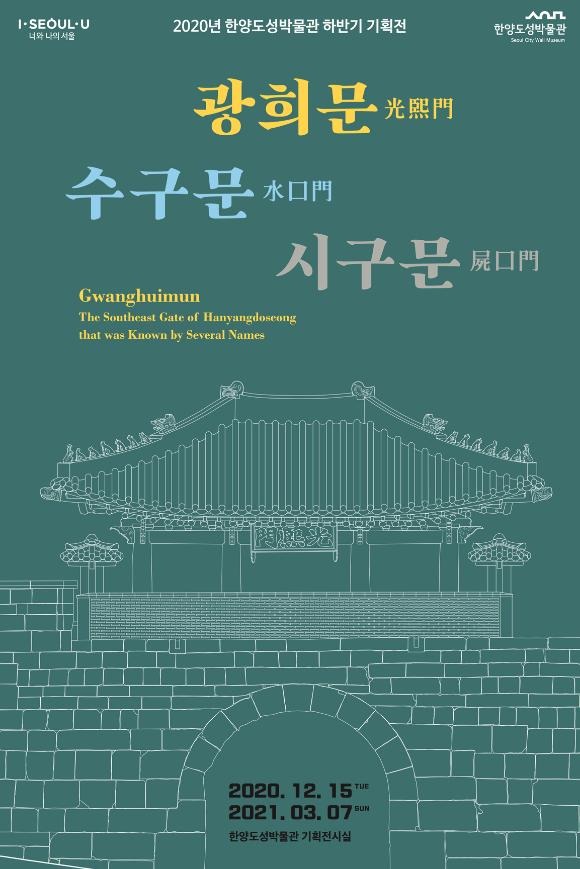
| Period| | 2020-12-15 - 2021-03-07 |
|---|---|
| Operating hours| | Tue-Sun:09:00~19:00 |
| Space| | Seoul city wall museum/Seoul |
| Address| | 283, Yulgok-ro, Jongno-gu, Seoul, Republic of Korea |
| Closed| | Mon, 1.1 |
| Price| | Free |
| Phone| | 02-724-0243 |
| Web site| | 홈페이지 바로가기 |
| Artist| |
|
정보수정요청


|
|
Exhibition Information
			Gwanghuimun Gate was a gate that guarded the southeastern part of Seoul City Wall. It was built between Sungnyemun Gate and Heunginjimun Gate. It was the main entrance of the people who came and went out of the city's east during the Joseon Dynasty. Because it was a door that was closely connected to the lives of the people, it was also called the gate that was more nicknamed than any other gate in Hanyangdoseong. It was named Gwanghuimun Gate, meaning "light shines all over the place to the distance", but it was more commonly called Sugumun Gate, and at the end of the Joseon Dynasty, it was also called the "mouth to move bodies."

Gwanghuimun Gate, which has endured several disruptions for more than 600 years, has changed as much as the names of the gates. In this exhibition, we will take a look at the history and changes of Gwanghuimun Gate and the southeastern gate of the city through the characteristics, roles, and historical events of Gwanghuimun Gate.


 Naver
Facebook
Kakao story
URL 복사
Naver
Facebook
Kakao story
URL 복사


