| Period| | 2025-09-12 - 2025-10-11 |
|---|---|
| Operating hours| | 11:00-19:00 |
| Space| | cdagallery/Seoul |
| Address| | 120, Achasan-ro, Seongdong-gu, Seoul, Korea |
| Closed| | Mon |
| Price| | Free |
| Phone| | 0507-1344-6044 |
| Web site| | 홈페이지 바로가기 |
| Artist| |
|
정보수정요청


|
|
Exhibition Information


			 Ingo Baumgarten: SEEN SCENE

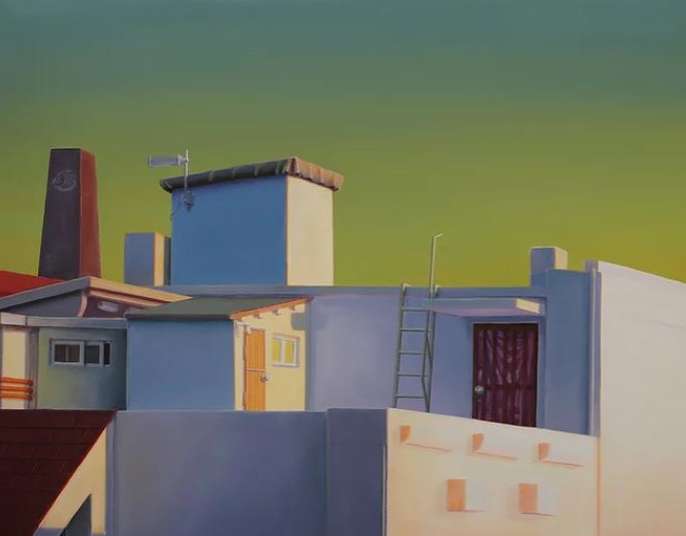
The title of Ingo Baumgarten’s solo exhibition 《SEEN SCENE》 carries layered meanings. ‘Seen’ refers to “that which is beheld” or “that which has been witnessed,” while ‘Scene’ denotes “landscape” or “setting.” Together, the phrase encapsulates the artist’s inquiry into how observed urban moments are transformed into painterly landscapes. Beginning with architectural fragments of everyday life, Baumgarten translates them into a language of color and line. In his canvases, the seemingly mundane—walls, windows, façades—are reconfigured into scenes that evoke cultural memory and emotional resonance.

Born in Hanover in 1964, Baumgarten studied at the “Staatliche Akademie der Bildenden Künste Karlsruhe” and the “École Nationale Supérieure des Beaux-Arts de Paris”, later receiving his MFA from Tokyo University of the Arts in 1999. Since 2008, he has served as professor in the Department of Painting at Hongik University, establishing his practice in Seoul. His sustained artistic concern has been the hybridity of architecture and lived experience within urban neighborhoods. When he first visited Seoul in 1993, the dense vistas of red-brick and concrete houses climbing the hillsides struck him as at once unfamiliar and compelling. He has since focused on the hybrid landscapes born of the encounter between Western architectural order and Korean sensibilities of habitation, articulating them through his visual idiom.

The works presented in this exhibition are distinguished by their restrained yet luminous palette: cool greens and blues, ochres and grays, accented with sparing yet vivid reds and dark browns that animate thresholds of windows and balustrades. The pictorial field is dominated by horizontal and vertical geometries, yet punctuated by acute angles and asymmetries that disrupt mechanical regularity and create a subtle, syncopated rhythm. Particularly emblematic is 3 open window (2025), depicting three windows on a building façade, all opened at the same angle. The blue surfaces of the panes absorb the morning light with crystalline clarity, while the shifting shadows and overlaps generate a secondary space within the painting itself. This work powerfully symbolizes the transformation of the seen into the scene.

Baumgarten’s gaze lingers at thresholds—on the corners of buildings, the interstices of façades, or the seams where aged dwellings meet contemporary structures. These junctures juxtapose temporal strata, embedding within them traces of Korean everyday life. His canvases are not mere architectural records but evocative dispositifs of lived narratives. This recalls Homi Bhabha’s notion of the third space, where heterogeneous cultural idioms intersect to engender new meanings. Through the perspective of an outsider, Baumgarten discloses the Korean urban landscape anew, revealing sites that, though familiar, often escape our perception. In them, one senses the liminality of dawn, when night and day overlap, and the aesthetics of jeophwa (接化)—a Korean sensibility of synthesis and permeation—emerge.

《SEEN SCENE》 thus becomes a space of visual dialogue between artist and audience. The works breathe together through variation and repetition, enabling viewers to experience a quiet yet dynamic rhythm. This resonates with Walter Benjamin’s insight that “novelty emerges through the interruption of continuity.” Baumgarten conjures this sense of novelty as a dawn-like sensation, asking: What we have seen—into what kind of scene does it remain within us? This exhibition unfolds within that very question, stirring memory and perception as it opens toward the viewer.

  written by JaeIn Kim(Ph.D. Program in Art History at Myongji University, SAI ART Director)


 Naver
Facebook
Kakao story
URL 복사
Naver
Facebook
Kakao story
URL 복사