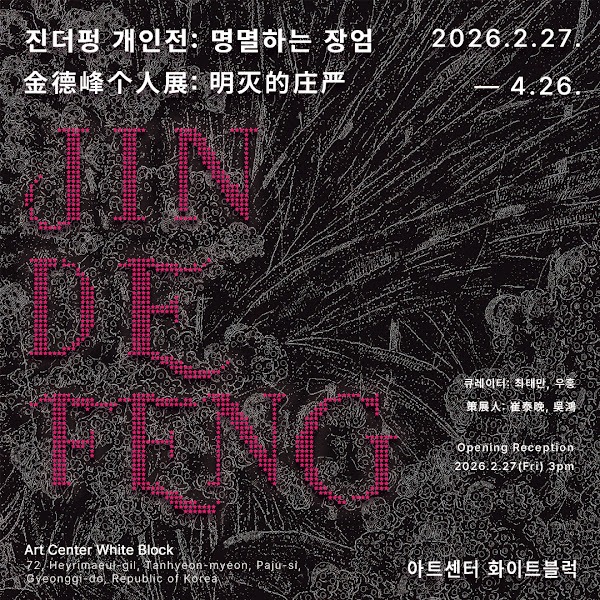
| Period| | 2026-02-27 - 2026-04-26 |
|---|---|
| Operating hours| | 11:00~18:00 |
| Space| | Art Center Whiteblock |
| Address| | 72, Heyrimaeul-gil, Tanhyeon-myeon, Paju-si, Gyeonggi-do, Republic of Korea |
| Closed| | Open throughout the year |
| Price| | |
| Phone| | 031-992-4400 |
| Web site| | 홈페이지 바로가기 |
| Artist| |
진더펑
|
정보수정요청


|
|
Exhibition Information
			Flickering Sublimity


Under the theme of “Breaking Painting (破畵),” Jin Defeng (金德峰) has developed a body of work comprising three series: Broken Shell (파각, 破壳), Hole (파동, 破洞), and Decoding (파해, 破解). Broken Shell, which literally means smashing a shell, signifies a rupture of boundaries. In Hole, by contrast, innumerable perforations puncture the pictorial surface; these voids, like black holes, seem to draw the image inward, and the dark wounds—like scars on a torn canvas—open onto an abyss of emptiness. Decoding pursues the homogenization of the surface through the repetition of identical forms or patterns, yet it also reveals an intention to decipher or recompose meaning through drifting signs, like signifiers. All three series begin from the idea of “breaking” and carry a declarative message: a refusal of the stale conventions that have long governed art.

This impulse toward destruction is unlikely to be unrelated to the shock of Xiamen Dada, a current within the Chinese contemporary art movement that Jin witnessed while attending art college in Xiamen. Memories of the radical performance art shown at the time by figures such as Huang Yong Ping (黄永砯) resurfaced when, after his first solo exhibition in 1992 in a realist style, he sought a method uniquely his own. More directly, the reality he encountered in 2008 after establishing a studio in Songzhuang (宋庄), Beijing—a period of critical reflection on a Chinese art world that, amid rapid capitalist transformation, chased only immediate profit—shaped and influenced his work. In fact, he has stated that before returning home to Xiamen, he cut up with scissors all the works he produced during the eight months he lived in Songzhuang. This act recalls the pain of the bird breaking out of the egg as portrayed by Hermann Hesse in Demian. In order to make work different from others, he sublimated the Dada spirit of negation and destruction into a destruction of pictorial convention itself.

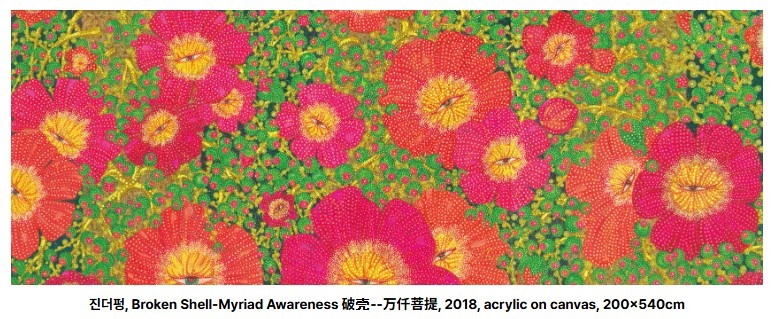
To understand why he is so deeply preoccupied with acts of breaking, we need to consider representative works from these three series. In Broken Shell——the canvas is filled with red-toned petals and green forms composed of circles. The red of the petals is itself packed with countless circles and dots, and, together with the optical stimulus of complementary colors, the entire surface seems to become a dazzling festival of light and color. Even the heavily painted areas between the petals and the green disks are constructed from innumerable color-points, so that depth and perspective vanish and the image is reduced to a homogeneous plane. Despite the tremendous labor of rendering not only each dot but even the lines that determine the contours of form with exquisite care, the result looks strikingly digital. Yet unlike the dry outcome produced by a mechanical digital process, his work carries the breath of life, precisely because it is the product of relentless labor that is almost ascetic in nature. Though it appears to depict a flower shot at close range, the craft-like virtuosity and ornamental intensity—born of an insistence on missing not even a single “cell”—unexpectedly produce a surreal landscape. The eyes painted into the center of each petal evoke the eyes of Buddhas or bodhisattvas in Buddhist paintings (佛畫). These eyes draw us into the lavish image; from another angle, they also make us feel that our own existence is being exposed by the gaze within the painting. The countless “gazes” hidden behind the flower’s beautiful ornamentality, which generates an uncanny tension, simultaneously suggest both the fundamental loneliness of existence and the limitless expansion of perception.

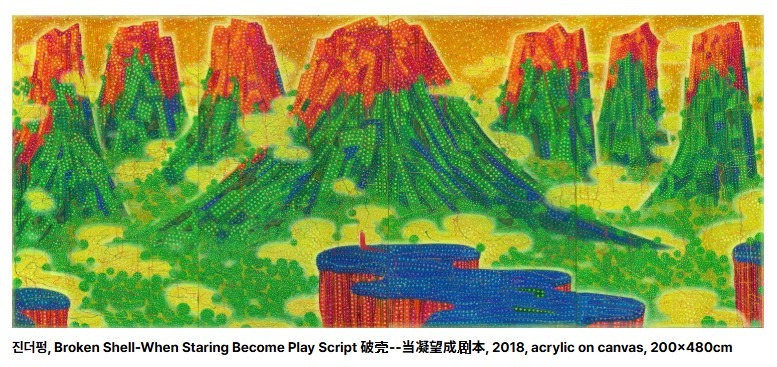
The work on the same theme, , fills a vast canvas with mountain ranges in green that stand in dramatic contrast to the intense orange and red of rising peaks. Because a figure in traditional dress stands on a blue cliff at the center, seemingly admiring this majestic nature, the work calls to mind grand-scale shan shui figure paintings (da jing, 大景). This landscape is less a depiction of real nature than a vision-like shan shui in which an inner landscape or violent emotion has been condensed. And yet the work has nothing to do with traditional landscape painting as such; it borrows only the compositional schema. Despite its sumptuous colors and the mysterious atmosphere created by transparent circles that resemble glass beads, what one feels is “loneliness,” because this is not the world on which we actually set foot, but an isolated, oneiric (夢幻) space.

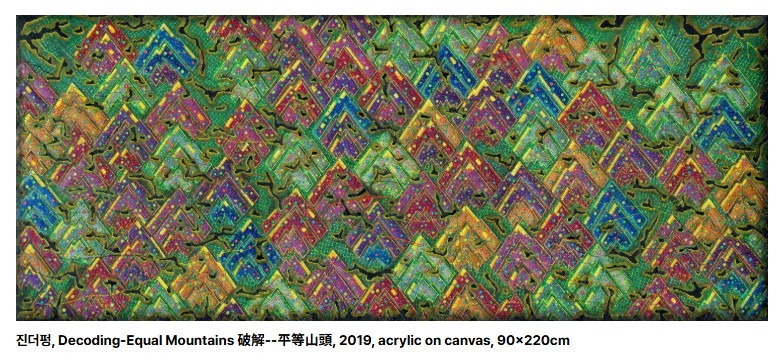
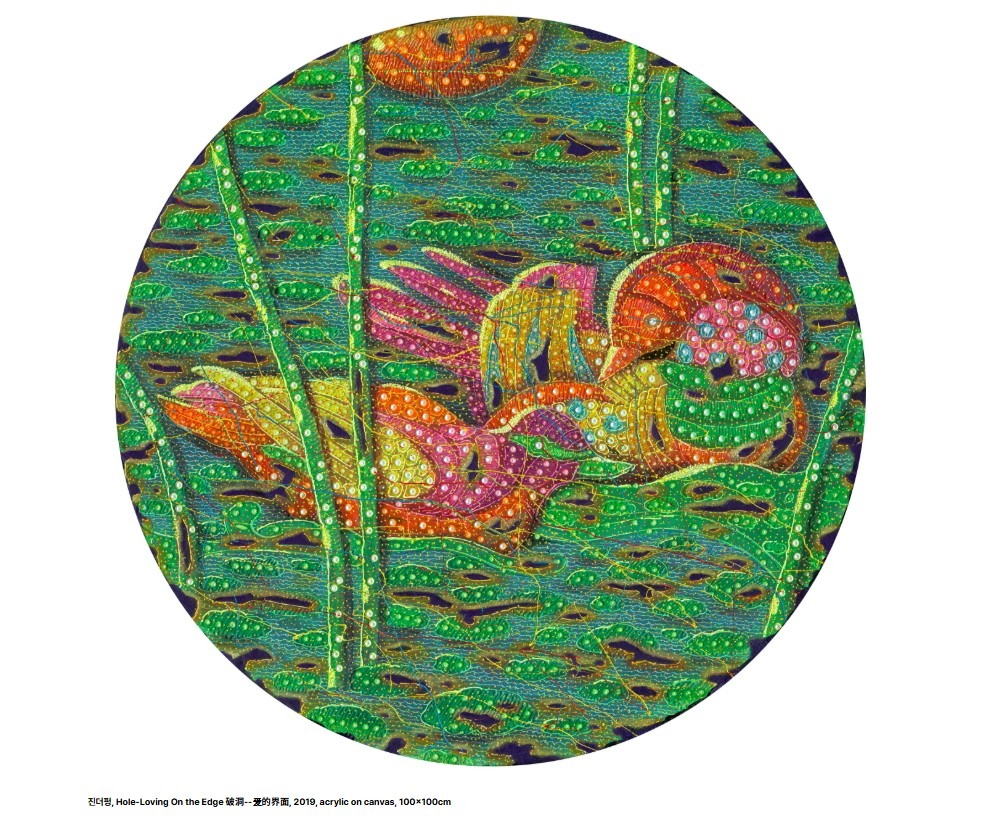
In these two works, the overwhelming scale—set against their sumptuous surfaces—makes one feel even a kind of sublime beauty. By contrast, the formal hallmark of the Hole series, which concentrates on animals, figures, and plants at a human scale, lies in the innumerable black apertures puncturing the surface. These holes, at once fissures in a brilliant skin and entrances that pull us into an unfamiliar world we do not know, lend the image both vitality and spatial depth. They are also “breathing holes” that make the forms, colors, and connecting lines that fill the surface seem alive. Looking at , which depicts a pair of ducks or mandarin ducks gliding calmly between aquatic plants, one may recall the bird-and-flower paintings of Emperor Huizong (徽宗) of the Song dynasty. In this sense, it would not be unreasonable to call this beautiful and lovely work a twenty-first-century version of bird-and-flower painting. Likewise, one may think of Buddhism when encountering the Buddha figures that appear in this series, but in Jin’s work the meaning carried by the figure is not what matters. This becomes clearer in the Decoding series, which repeatedly fills the surface with the same patterns, emptying the figure of narrative meaning. One example, , presents a homogenized structure in which the natural object “mountain” is replaced by geometric patterns. Here the mountain is no longer nature; it is a quantified and diagrammed sign of modern civilization, and a symbol of standardized systems in modern society. Depending on how one looks, the repetition of identical patterns—potentially meaningless—can even appear craft-like.

Having resolved to break painting, Jin drew on Chinese traditional crafts such as Suzhou embroidery(苏繡) and the fine wirework of cloisonné enamel (景泰蓝), as well as the vivid primary palette of traditional New Year prints.In order to create a method uniquely his own, he devised a way of “regeneration through destruction (毀滅重生)” by drawing on the compositional aesthetics of two-directional repeats and four-way all-over repeats. In other words, he first uses printmaking techniques to establish a yin–yang structure on the surface, then applies dots so that the picture appears like a living organism composed of countless cells. In his images, line functions like the meridians (經絡) in traditional Chinese medicine—the channels through which qi and blood flow—serving as capillaries that give life to the surface. To see these works effectively requires three modes of viewing. One begins with distant viewing (遠觀), keeping a certain distance to take in the surface image, the distinctive effects of light and color, and the optical qualities produced by materials and technique. From there one arrives at middle viewing (中觀), where material and texture interweave with the surface image and generate collisions between vision and meaning, prompting viewers to reconsider the layering and distortion of meanings produced by shifts in the image. Finally, only upon reaching close viewing (近觀)—standing near the surface—does the image itself recede, while material and texture, grounded in the visual destruction and semantic distortion experienced at the middle distance, complete a process of visual regeneration and the reconstruction of meaning.

In Jin’s works, the brilliant primary colors, unmixed and pure, clearly derive from New Year prints. Yet it is equally important that the fluorescent hues and neon-sign effects—no less striking than the primaries—are stimulated by Xiamen’s urban culture, a symbol of China’s reform and opening and a city overflowing with dazzling artificial light produced by the expansion of capital. The modern aesthetics he witnessed was a dual landscape in which the golden glow of prosperity coexisted with the darkness of disappearance. Rather than merely reproducing this volatile spectacle, he created surfaces where dazzling ornamentality and a lonely, empty abyss paradoxically coexist. He takes the momentary loneliness and anxiety evoked by the flickering illusions he found in Xiamen’s neon signs, weaves them into a system of lines like meridians, and draws on the surface a map of life in which generation and disappearance circulate. The innumerable lines are at once a net of life and an artistic acupuncture that heals the wounds of alienation embedded in the glittering city.

Jin’s work, visible in its relentless hand-made process, is the result of ascetic labor. He captures the city’s flickering fluorescent lights and floating lives to express an instant of illusion, yet he practices brilliance not as visual play but as a discipline oriented toward solemnity. His attitude and method reveal a process of reviving what is vanishing through an artistic ritual (儀式) called “solemnity.” Let us return to the fact that the point of departure for his work—within which an organic and dialectical process of generation–destruction–disappearance–regeneration is condensed—was “breaking painting.” In Chinese Chan Buddhism, Linji Yixuan (臨濟義玄), patriarch of the Linji school, preached: “If you meet the Buddha, kill the Buddha (逢佛殺佛).” This teaching, which urges one not to cling to conceptual objects of enlightenment—Buddha, patriarchs, or arhats—but to reveal one’s own nature, surely does not apply only to religion. In order to establish his own idiom, Jin sought to break the inertia of painting. What he sought to break was not only the form of painting, but also the fortified citadel (牙城) of fictional theories surrounding it. His ascetic devotion to relentless and severe labor in confrontation with the pictorial surface recalls the solemn act of Tibetan monks drawing mandalas with colored sand. Jin’s thought and method also resonate with the following passage from Demian: “The bird fights its way out of the egg. The egg is the world. Whoever would be born must first destroy a world. The bird flies to God. That God’s name is Abraxas.” If, for Hesse, the egg signifies a fixed system of values or the comfortable world of childhood, then for Jin it is both the traditional framework of painting and the glittering shell of material abundance in a highly capitalized society such as Xiamen. Just as Abraxas is a god in whom good and evil, light and darkness are joined, Jin’s works likewise hold together such ambivalence as yin and yang, generation and disappearance, brilliance and loneliness. Ultimately, the “flickering sublimity” seen in his work not only reveals this ambivalence with clarity, but is also the result of a painterly choice toward creation through destruction, and toward the integration of duality.

Choi Tae-man | Professor, Kookmin University · Art Critic
Translation by Zhou Sun (University of Toronto, Media Studies)


 Naver
Facebook
Kakao story
URL 복사
Naver
Facebook
Kakao story
URL 복사


