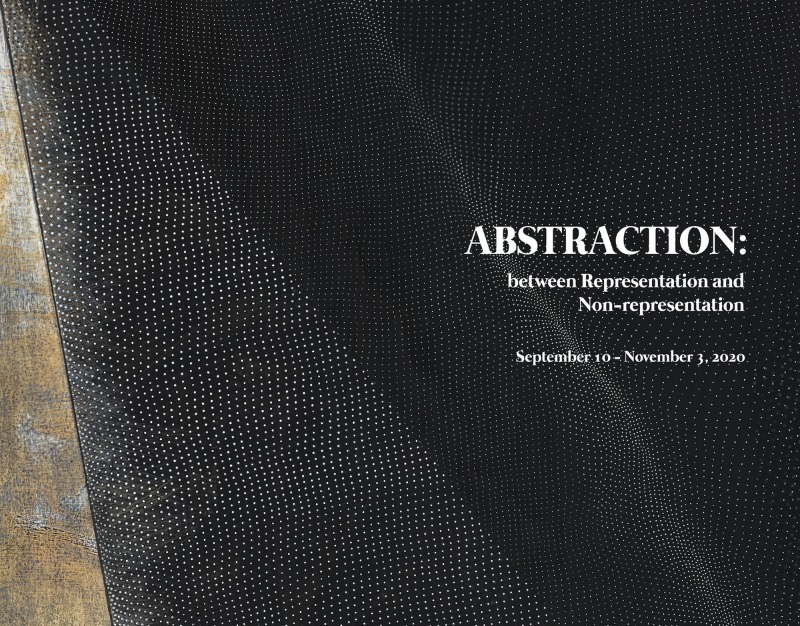
| Period| | 2020-09-10 - 2020-11-03 |
|---|---|
| Operating hours| | 9:30~18:00 |
| Space| | Jasonhaam |
| Address| | 73, Seongbuk-ro 31-gil, Seongbuk-gu, Seoul, Republic of Korea |
| Closed| | Sunday, Monday, Tuesday *By appointment only |
| Price| | Free |
| Phone| | 070-4477-7880 |
| Web site| | 홈페이지 바로가기 |
| Artist| |
Oliver Arms,George Condo,Derek Fordjour,Antony Gormley,Yayoi Kusama,Linn Meyers,Chris Ofili,Ugo Rondinone
|
정보수정요청


|
|
Exhibition Information
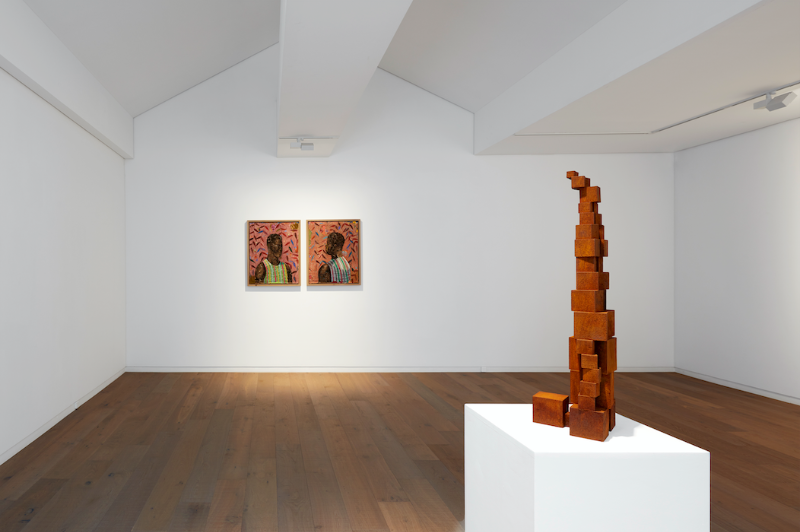
			Jason Haam is pleased to present ABSTRACTION: between Representation and Non-representation, a group exhibition featuring works by Oliver Arms, George Condo, Derek Fordjour, Antony Gormley, Yayoi Kusama, Linn Meyers, Chris Ofili, Ugo Rondinone, Emily Mae Smith, and Mary Weatherford.
The concept of pure abstraction, or non-objective art was first explored in the early 1900s with artists such as Wassily Kandinsky, Kazimir Malevich, Piet Mondrian, and Robert Delaunay—and was later championed by art critic and formalist Clement Greenberg beginning in the 1930s. Since then, Contemporary Art has existed along a continuum between representation and non-representation, with varying degrees of abstraction. The exhibition explores the complexity of defining abstraction in painting today while presenting multiple approaches that range on the spectrum from representation to non-representation.
Throughout the history of painting, the main objective of art was to portray and replicate likeness in reality. Art today has progressed in such a way that it is possible to still demonstrate likeness without replicating its exact visual features. Works by Emily Mae Smith, George Condo, and Yayoi Kusama are on view in the gallery’s first exhibition hall, demonstrating ways in which artists have reimagined past art historical genres.
Kusama’s Fruits (1984) portrays a traditional still life, executed in the style of the artist’s signature infinity nets. Similarly—Emily Mae Smith and George Condo both combine historical subjects and contemporary references to create works that are reimagined with each artist’s own visual language and style. Smith’s Devouring Saturn (2018) playfully reinterprets Francisco Goya’s famous painting—Saturn Devouring His Son (1819-1823)—while Condo provides a contemporary interpretation of religious iconography in The Virgin Mary (2009).
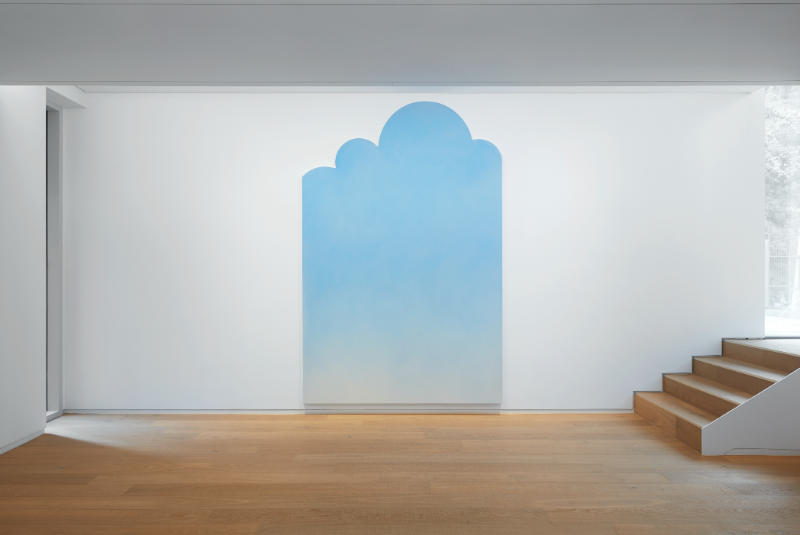
In the gallery’s second exhibition hall, Mary Weatherford’s Switching Yard (2016) faces Ugo Rondinone’s elfterjulizweitausendundfünfzehn (2015). Weatherford’s iconic abstract canvases with strategically placed neon lights directly reference specific places and memories from the artist’s own experience. In conversation with Weatherford’s abstracted landscape, Rondinone’s cloud painting compliments the scene with its animated form and seemingly endless sky filled with gradient blue hues.
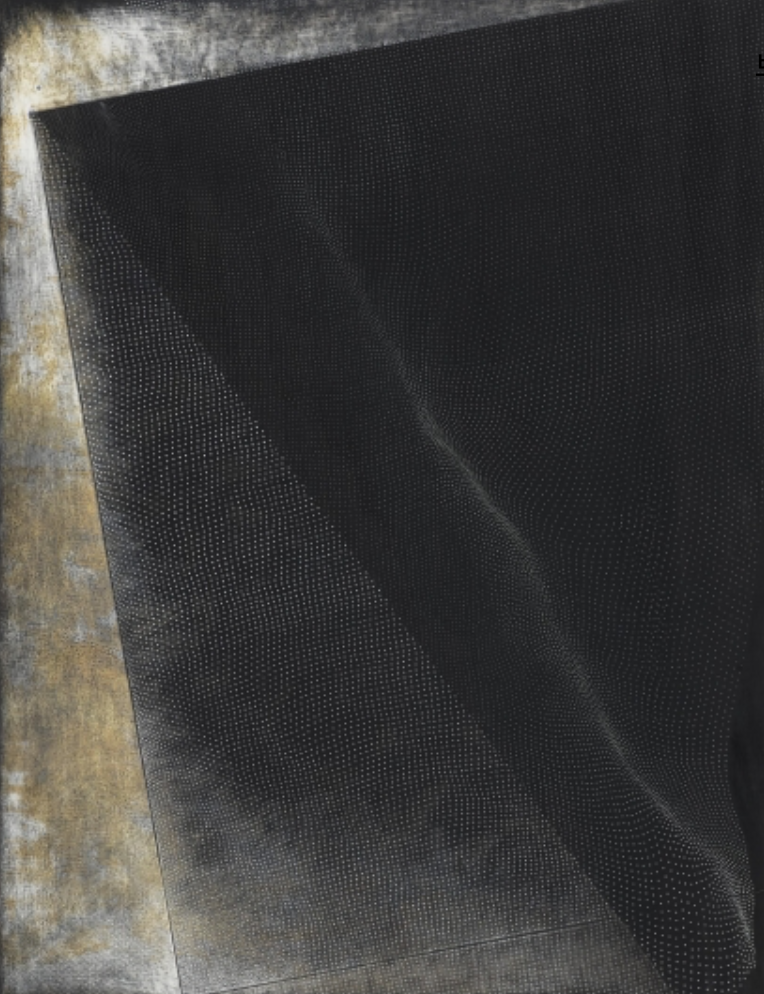
In the third exhibition hall, works by Linn Meyers and Yayoi Kusama are on view. Both Kusama’s ceaseless exploration of infinity—in INFINITY-DOTS [NFE] (2015)—and Meyers’s intuitive resolution between chaos and order—in Untitled (2020)—explore conceptual thought and unforeseen forces through visual form.
In the gallery’s fourth exhibition space, works related to human form, experience, and emotion are on display. Antony Gormley’s SMALL PUSH III (2019) provides an abstracted Cubistic rendition of the human form, while Derek Fordjour’s Couplet 30 (2018) provides an image of the human form abstracted through physical elements, such as fragments of newspaper and cardboard.
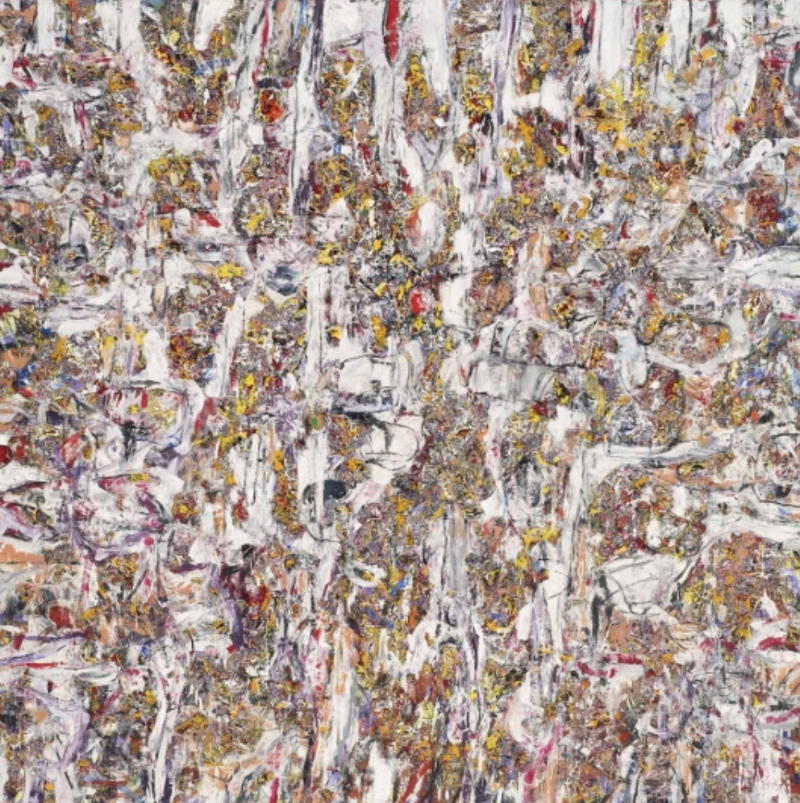
Chris Ofili’s Dancers in Blue (2006) and Oliver Arms’s Midwife (2012-2013) portray an abstraction of the human experience and emotion through formal visual elements. Although lacking in any form of figuration—as its title suggests—the warm yellowish hues in Arms’ work evoke and recall feelings associated with warmth and maternal affection. Similarly, in Ofili’s work, two figures are clearly outlined, but it is the deep blue hues imbued throughout the work that create an enigmatic ambiance—demonstrating the ways in which color becomes a formal device to suggest human emotion and experience.


 Naver
Facebook
Kakao story
URL 복사
Naver
Facebook
Kakao story
URL 복사


